Thank goodness for the Farmers’ Market. Still open which means I can shop outside, buy produce straight from the farm and treat myself to things I wouldn’t normally buy. Nothing is normal. Or should I say, as everyone else is, we have a new normal.
‘Normally’ I would cycle here every Sunday morning, arriving just after 10am. But now the entrance is one end of the market and the exit the other, entailing a circuitous loop to return to my bike. So I walk, wheeling my bright green shopping trolley, light and bouncing on the way, laden and sprouting spinach leaves and rhubarb on the way back. There’s plenty of time, no need to rush home for the weekend chores before work on Monday. Furlough – I’m loving it.
The most direct route is about a mile but forays into tree-lined side streets sometimes double that. I know all the flats with window boxes, the streets with trees, the basements with creepers. Detours are made to see cherry blossom, the delicate lacy green of new leaf on a line of silver birch, to trace the perimeter of a private square with its locked gate. In the eerie quiet of central London under Covid control I spy a dunnock foraging in the ivy curtain spilling from a neglected street planter. It’s the first time I’ve seen one in the street, away from a park. Is it always here? Am I taking it more slowly, giving me time to notice the shy little grey and brown bird that behaves like a mouse?
Two Sundays ago I took a slightly different way home, detouring to go past a red brick, smart Marylebone block and a specific ground and basement floor flat. A cottage garden, mini jungle, scented and lush climbing and reaching through the street railings from the basement area. Improbable but a fixture for the twenty or so years I’ve known it. A space packed with life in every season.
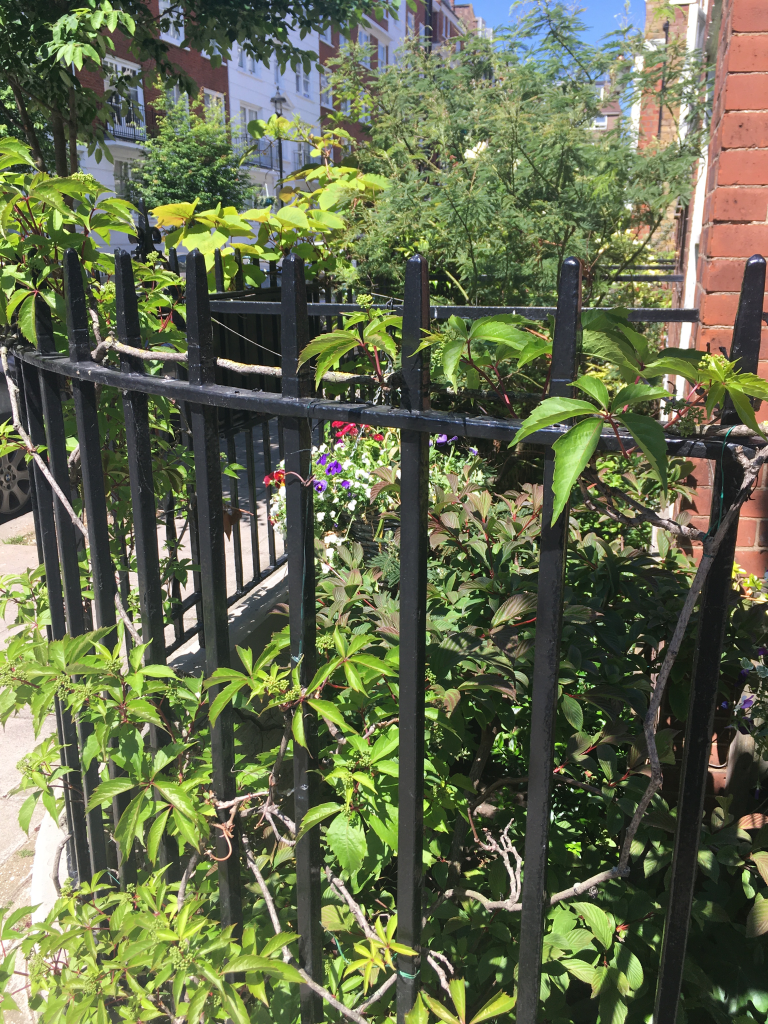
Just before I reach it I hear an unmistakable sound. The insistent, repetitive cheeping of baby birds in the nest. With an adult present or they would be silent. I stand stock still, moving my head rapidly from side to side, trying to pinpoint the direction from which the sound is coming from. Down the street, a little further. It’s not coming from above. A low down nest, a hole in a building, a drainage pipe. My eyes cast frantically around, knowing the adult won’t stay long.
And then I see it. A tiny streak with a flash of blue flits between the railings at my knee height and rises into the street tree opposite. A blue tit. Off on the search for more caterpillars and spiders to feed those gaping mouths. I wonder how many, how old are they, will they fledge successfully, where do the parents find enough food? I peer through the railings where it appeared, searching for a likely nest site then step a little further away and wait, knowing she’ll return soon. (There, I’ve given ‘her’ a gender. I tried to avoid it as they’re hard to tell apart but even though the males also feed the chicks it is something we associate with Mummy Birds.)
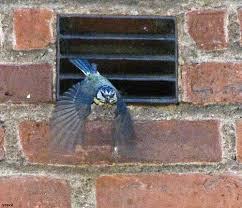
Here she comes! Looping across the road, briefly stopping on top of the railings to check it’s safe, then down into the basement and disappears into a ventilation brick. I hadn’t really noticed them, but at regular intervals along the wall old terracotta slatted bricks, perfect for the entry of a tiny bird. The cheeping crescendos as she enters, bill filled with tiny wriggling invertebrates and something with wings. If she’s bringing in larger insects the babies must be near fledging age, and the cacophony of their calls begins again. Feed me, feed me, feed me they all call together.
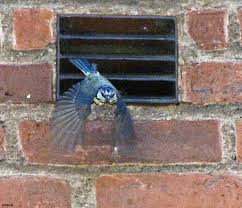
Not mine, but very similar!
All goes quiet but the adult doesn’t re-emerge. Is she burrowing down into the nest, winkling out parasites, searching for intruders? Her head pops out, faecal sac in bill and after a brief look around she’s off, removing the waste that might betray her nest to predators. The delay is explained and I imagine the puckered, featherless bottom of a baby bird presented upwards out of the nest and neatly expelling its packaged poo for the adult to remove. So clean, so practical and unlike mammalian mess.
I’ve been transported into their world but as the adult vanishes up the line of street trees, self-consciousness returns. I’m suddenly aware of being a middle aged woman with a sprouting trolley stood still for ten minutes peering into the basement of a block of flats. I look around but seem to be alone and continue my walk home. A bubble of joy rises in my chest and I laugh out loud.
The following week I set out for the same routine, this time a little sluggish. Another week into lockdown and it’s starting to feel a bit tedious. I’m zoomed out. Days of virtual exercise classes, reunions, a birthday, a baby shower, a performance. Wonderful to see everyone and I’ve been overwhelmed by the warmth and camaraderie. But hours of screen focus have brought on a thick lethargy. The morning’s cooler and a little overcast. The trees have already lost that bright and shiny early spring outfit and are maturing to a deeper summer green. The browning, wilted leaves and crisped mustard petals of old daffodils hang from windowboxes.
As I near the market a woman is walking towards me with a droop-tailed grey hound on a lead. Her head is down and I move to the pavement edge to maintain our 2-metre distance. My stomach lurches and heart squeezes as I notice she’s weeping, audibly.
“Are you ok?” I ask pointlessly – of course she isn’t.
“Yes thank you, I’ll be fine,” comes the very British response. Neither of us moves. All I want to do is put a comforting hand on an arm, offer a consoling hug. But I can’t. She continues to weep, not trying to control her sorrow then says,
“Actually my Dad died last night and I couldn’t be with him.”
“Not of the virus,” she quickly adds. “He’s been ill a long time but was in hospital and I wasn’t allowed in.”
It’s awful. I offer sympathetic sounds, hopes that her dog provides some comfort. She smiles sadly, tears still flowing, and thanks me for stopping. We move away from each other, she with her weighty burden and me wheeling my empty trolley.
The sun comes out as I do my shopping. The first asparagus is here and one stall has very early strawberries. I chat as usual to my favourite stall holders, the potato man, the egg lady, the quiet meat man with his witty, nerdy teenage son – “we accept everything but bitcoin”. Slowly the pain of the earlier encounter recedes but leaves a melancholic tinge and my mind keeps returning to her helpless grief. Trolley full I start to head home then remember the blue tits and the garden I never reached the previous week. My mood lifts a little and I adjust my route to take them in.
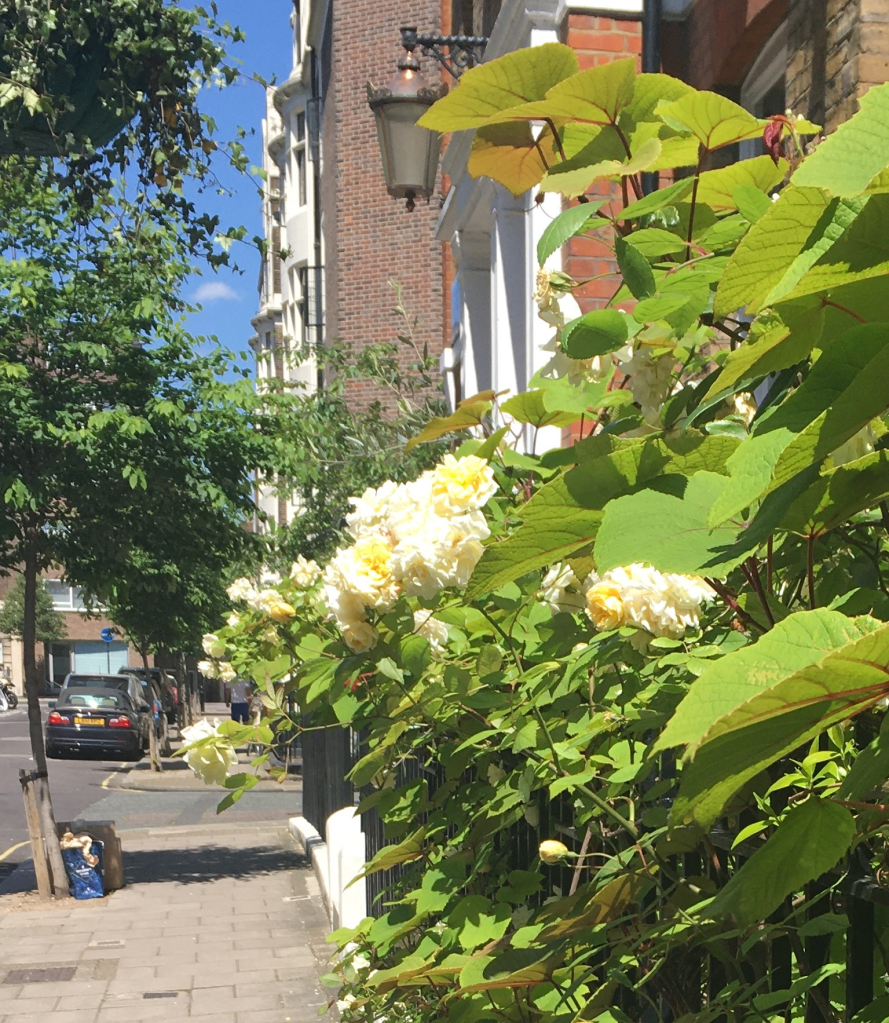
Butter yellow roses spill over the railings and I bury my nose into the warm scent. A bumble bee rises heavily out of a neighbouring flower, proboscis unfurled, pollen sacs bulging orange on its legs. The young lacy red leaves of an acer reach up to me. On the steps to the front door a potted lavender has raised its flowerhead spears, ready to royally release the purple blooms in a month or so.
Suddenly above me the air is alive with swooping, chirping, peeping. Fledglings are on branches, vibrating their still fluffy wings, mouths agape their four-note insistent calls demanding food. There’s another on a window ledge, one clinging to an overflow pipe, two whizzing across the road in dipping flight. I count eight and two adults. Great tits this time, not blue. Larger, louder, vibrantly full of life. I watch in delight, spinning around as another calls from behind me. Neck craned I look directly above into the tree trying to find the youngsters as they flit around, still begging but also helping themselves to whatever moves and catches their eye. Vrrrrr, vrrrrr, vrrrr as they whir around, not quite masters of flight but getting there. A piercing, more controlled call from an adult and the whole family fly off, dipping and looping.
My cheeks ache from the broadness of my smile, my heart is beating and my step is light as I turn towards home, mind full of the Marylebone tits.

 Wild About Life