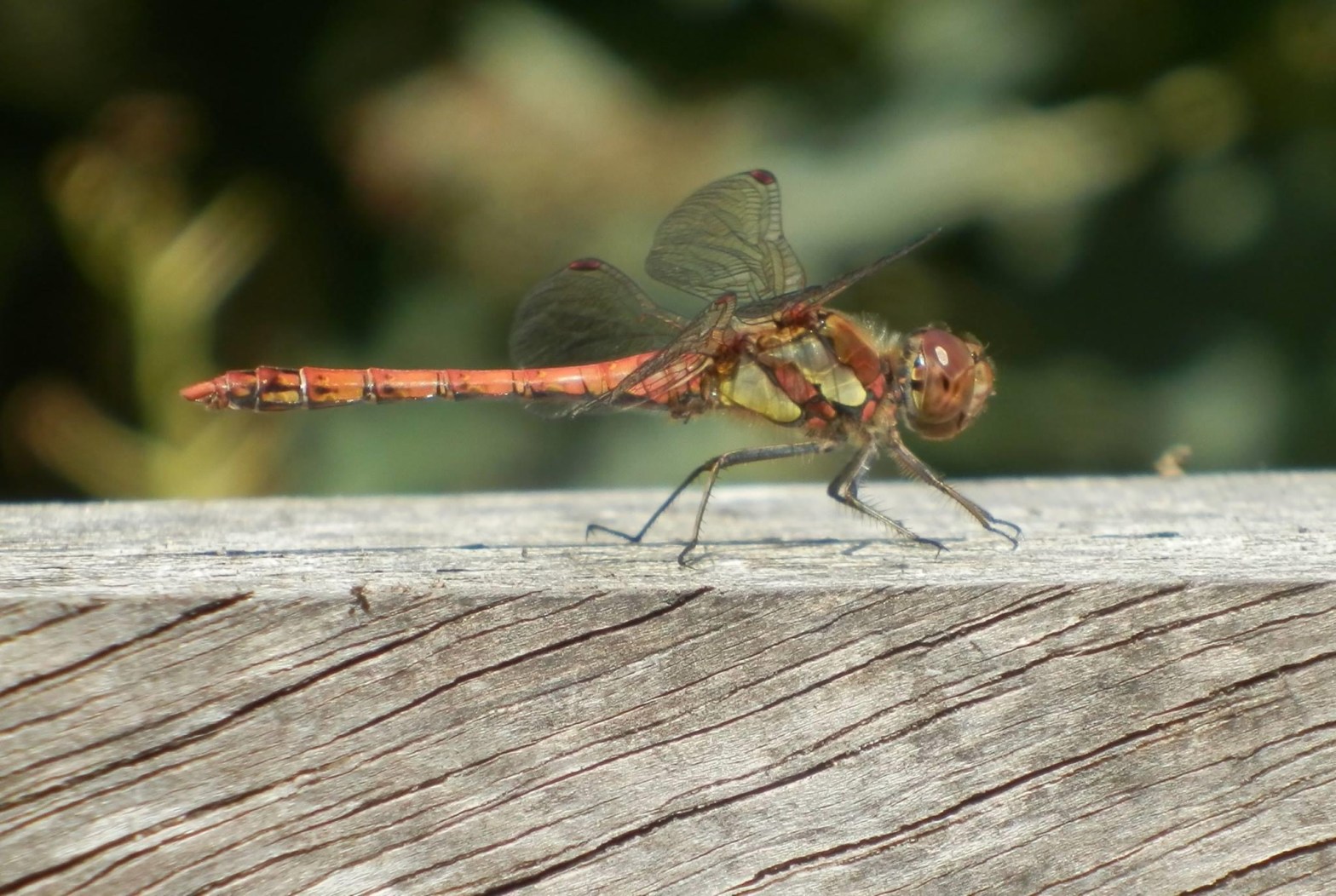
My introduction to Odonata
I grew up in a suburb of Harare, Zimbabwe1, in the beautiful high plains of continental Africa. The landscape around Harare was open grassland with ranges of low rocky hills and some enormous granite outcrops. Local rivers were small and seasonal, raging torrents for a brief spell when the rains broke, dwindling and disappearing in the dry season which could last as long as eight months. Not a great habitat for dragonflies and damselflies, insects of the order Odonata, that spend most of their life cycle in water.
But there were dams. Some no bigger than ponds and others vast lakes that provided both power and water to the country. Visiting a dam for fishing, game viewing, birdwatching, a walk or a picnic was a regular weekend activity for many families. And it was on one such outing that I first encountered dragonflies.
Our family was walking up to the dam wall at Lake Chivero2 when suddenly flying around my legs out of the reeds was a cloud of fluttering insects, darting and diving, their wings glittering like shards of glass. Fifty years on I can still recall the brief lurch of fear followed by utter joy and fascination as they danced around me.
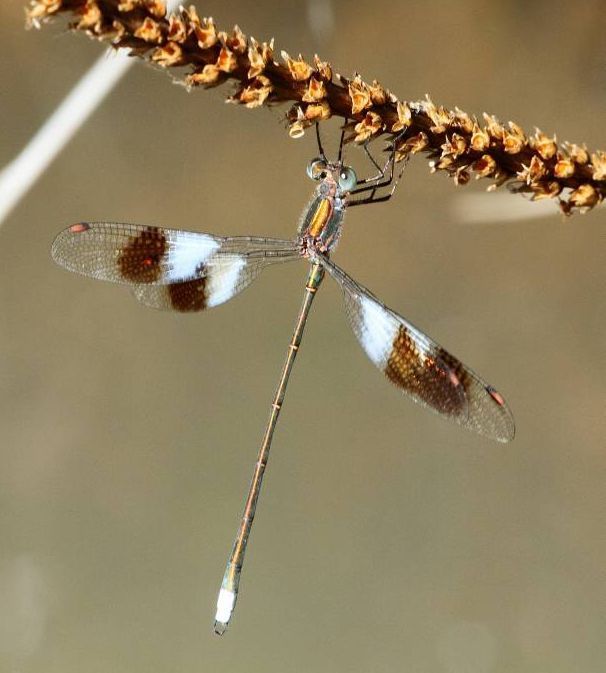
I think now they were probably damselflies as the flight behaviour was much more like the flitting of a banded demoiselle and there are endemic species in Zimbabwe. Whatever they were they have led to a lifelong love. In recent years I’ve become familiar with not only the adult form but also the intriguing, alien-like underwater existence of the earlier parts of their life cycle.
On subsequent visits to that dam the same thing happened and my father started calling them “Alison’s friends”. Even now, whenever I’m watching dragonflies and damselflies I think of them as my friends and it makes me feel special and chosen.
Below is a guide to telling these beautiful insects apart and some fascinating facts about them.
Classification
Dragonflies and damselflies belong to the order Odonata. This means ‘toothed jaw’ and refers to the serrations on their mouthparts. Dragonflies and damselflies are predatory in both their nymph and adult forms, hence their ferocious jaws. The order has three suborders, two of which are found in the UK.
Anisoptera – dragonflies
Zygoptera – damselflies
Wings
Both dragonflies and damselflies have two pairs of wings. All four can move independently of each other, resulting in their extraordinary flight capabilities. They can fly in any direction – up, down, forward, back and every option in between – making their world three dimensional and very different to our experience as humans.
Dragonflies can be superbly acrobatic in flight, changing directions in an instant to catch prey on the wing or chase away anything encroaching on their territory. They can also dive into water to escape predators such as the hobby, a small bird of prey and summer visitor to Britain.
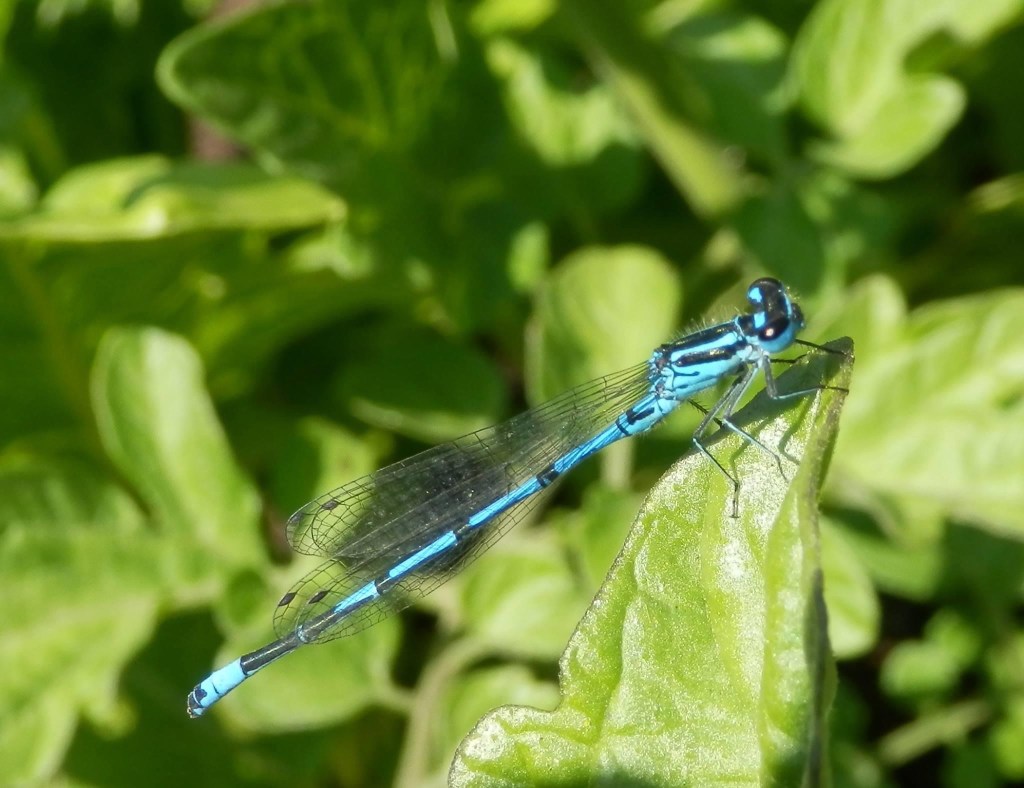
Damselfly – common blue male wings folded 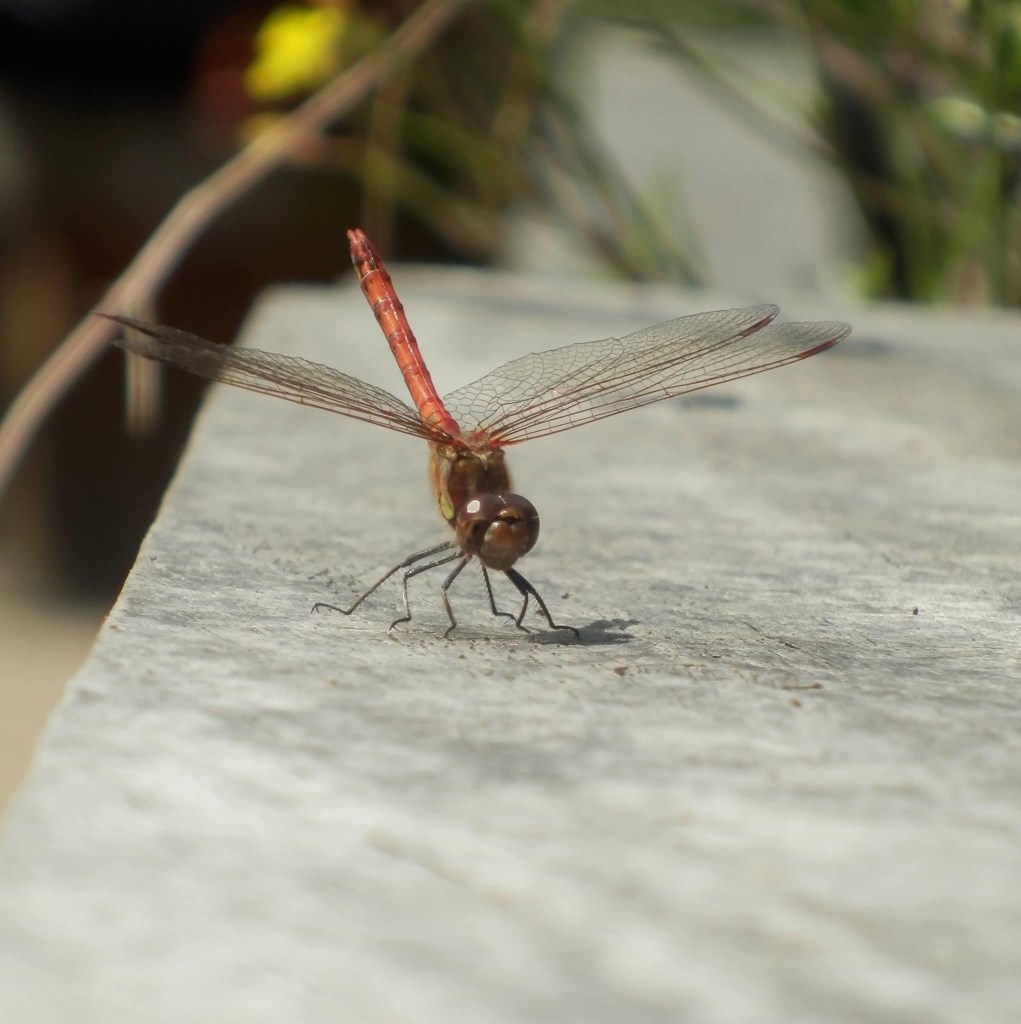
Dragonfly – common darter male, wings out to side
The obvious difference comes when they land. Damselflies fold their wings behind them along or above their abdomen, forewings folded over rear wings. Dragonflies hold theirs out sideways, at right angles to their body. All four dragonfly wings are visible, the hindwings often shorter and broader than the forewings.
This applies to all species no matter how large or small. A large damselfly may be near the size of a dragonfly but with still fold its wings. A small dragonfly, still usually bigger than a damselfly, will always hold its wings out sideways. It is the easiest and quickest way to tell them apart. You don’t have to be that close and it nearly always applies.
Size
Damselflies have a more delicate build. Their abdomens are long, narrow and slender. Their wings too tend to be narrower than a dragonfly’s though this is not always the case. Some, known as demoiselles have wide wings and the males sport characteristic markings making them easily recognisable.
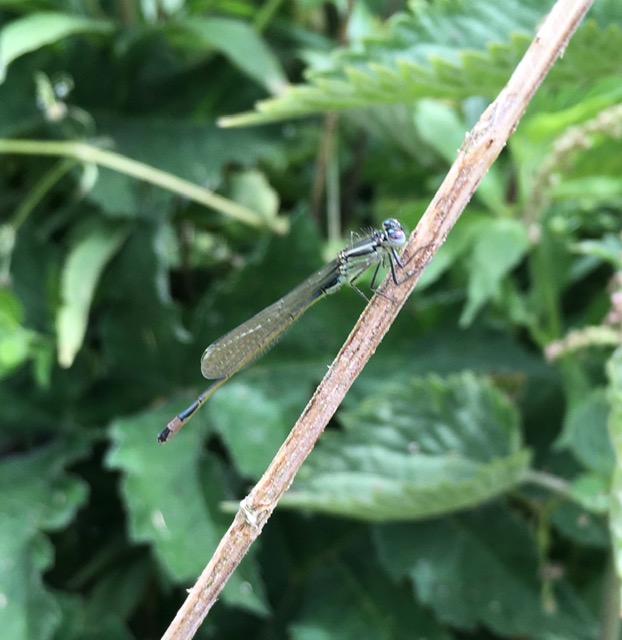
Delicate damselfly perching in the undergrowth 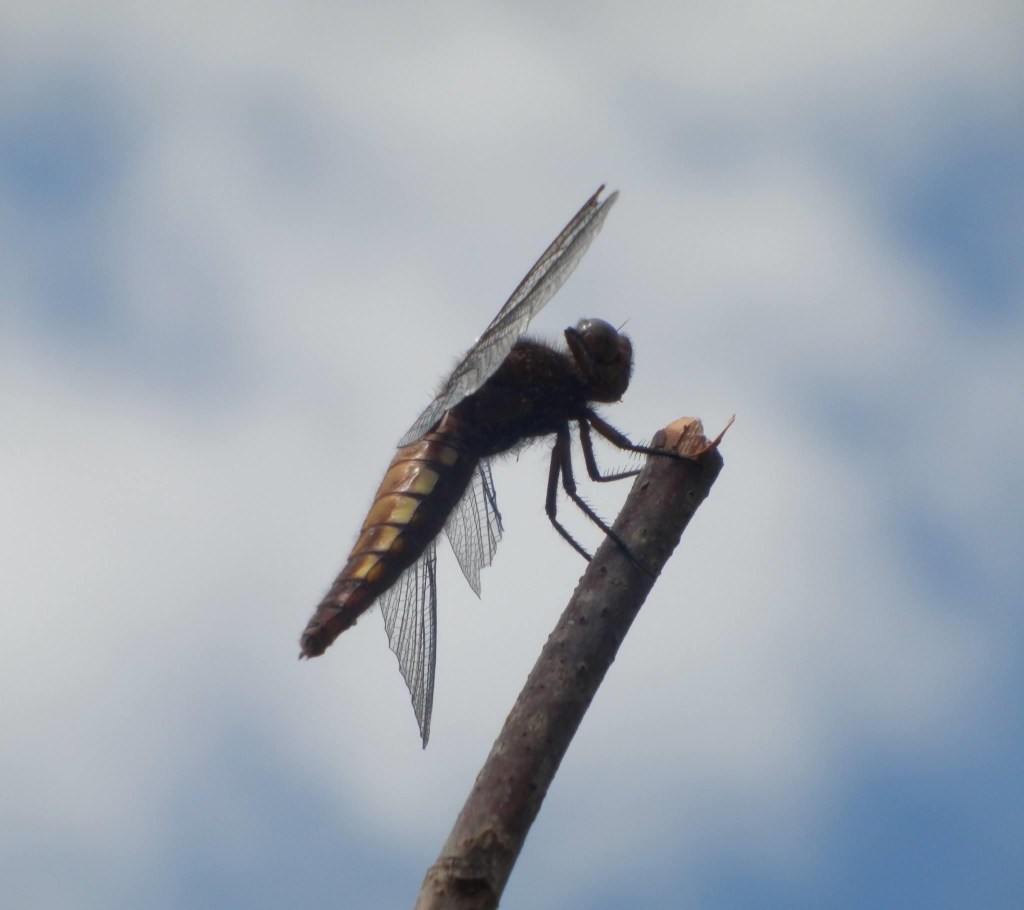
A broad bodied chaser dragonfly surveying its territory
Dragonflies are much heftier insects. The largest in Britain is the emperor Dragonfly, up to 80mm long and with a body over 10mm wide. As their name suggests, broad bodied chasers have wide, flattened abdomens and look very chunky. The wings are broader. Even the more slender dragonflies known as hawkers have abdomens much broader than a damselfly.
Eyes
Dragonflies – their eyes are extremely large and usually touch at the top of the head. Dragonflies have the best vision of any creature on earth. Each eye is multifaceted, in effect containing thousands of lenses. Compare that to our one! They can see all around them, 360 degrees at the same time. This makes them superbly efficient predators but equally good at avoiding predation.

Damselflies – also have extremely good vision with compound multifaceted eyes. Their eyes are smaller in relation to their body and are situated on the sides of their rectangular head.

Behaviour
Dragonflies are bold and confident hunters, visibly quartering up and down ponds or across meadows as they seek out their prey. They will predate most insects, catching some on the wing as well as taking beetles and larger prey off the ground. Larger varieties are audible, their wings making a distinctive buzzing sound.
The larger species are curious. They will approach rather than avoid you, checking you out and determining whether you are threat or not. One of my most remarkable wildlife experiences is being eyeball to eyeball with a hovering emperor dragonfly at the London Wildlife Trust’s tiny little nature reserve Gunnersbury Triangle.
You are more likely to see damselflies flitting about in the long grass of meadows and through the aquatic marginal plants of ponds, rivers and canals. They will fly in short bursts, regularly stopping on grass stems. They are less likely to perch out in the open making them harder to spot as their slender bodies blend in with grass and reed stems.
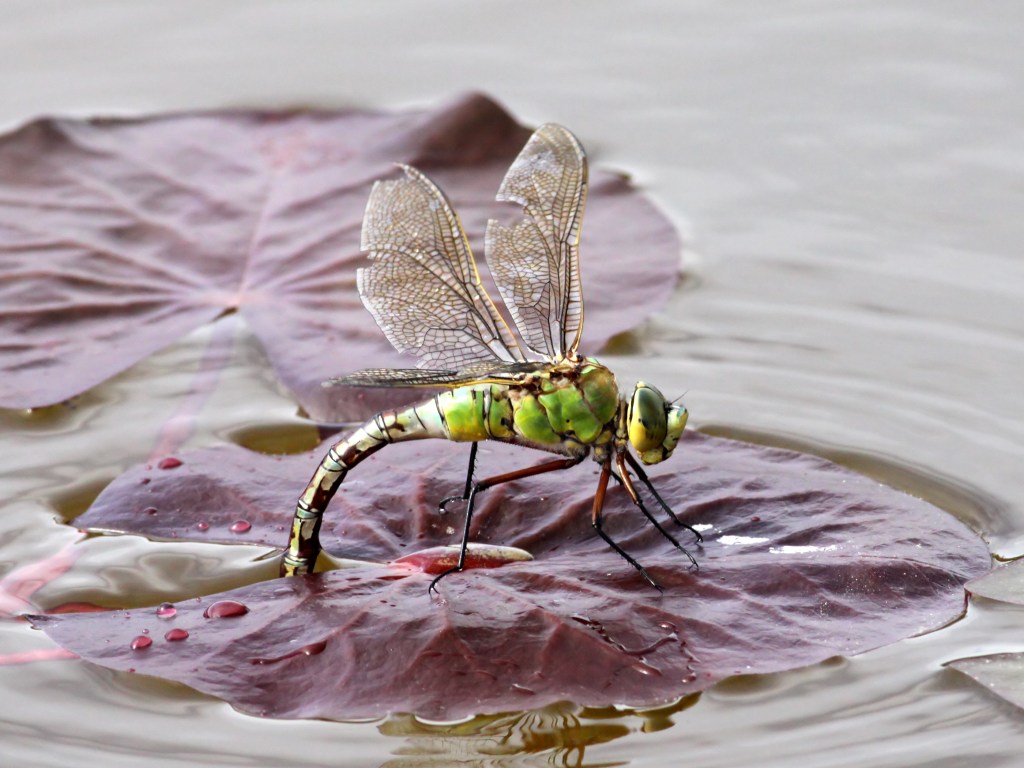
Emperor dragonfly ovipositing c. Ken Billington 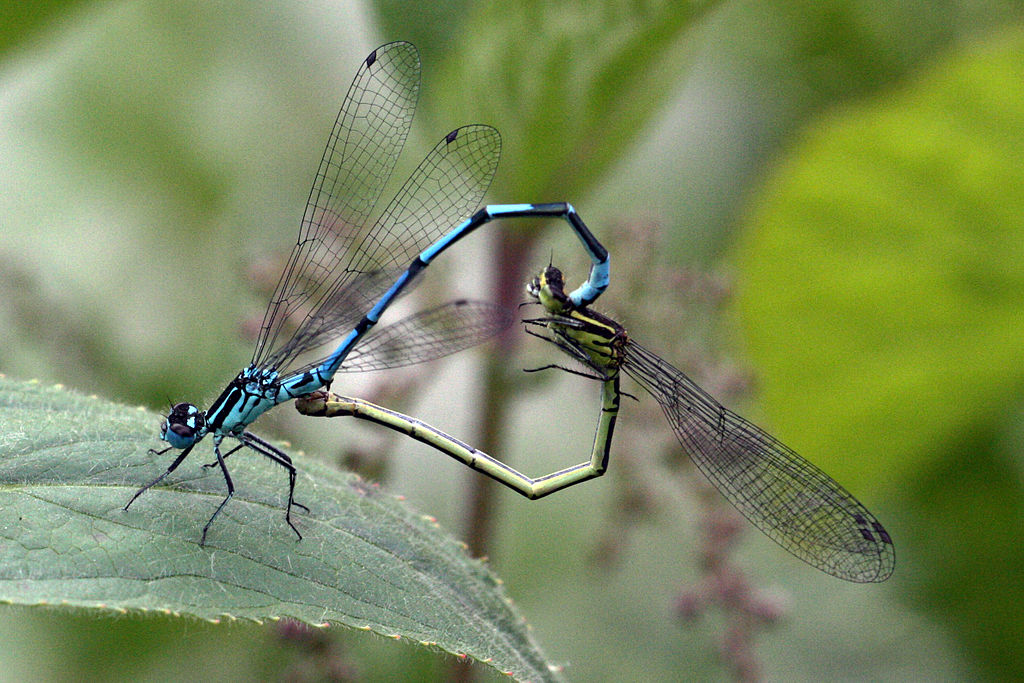
Azure damselfly mating wheel c. Charles J. Sharp
One of the best times to view both suborders is when they are laying eggs. Dragonflies may lay directly into the water, females repeatedly dipping their ovipositor (an egg laying tube common to many insects) below the surface. Both lay into the leaves and stems of water plants, piercing the tissue with adapted ovipositors.
Both may form a heart-shaped mating wheel during copulation. The male grips onto the back of the female’s head with pincers while she curls her abdomen around to pick up sperm from the base of his abdomen or after it has been transferred to nearer the thorax. They will often remain clasped together until the female has laid her eggs, the male not wanting to relinquish his hold and risk being being supplanted by another male.
Quick check
Dragonflies
- wings out sideways, 90o to body
- big eyes touch on top of head
- chunky and robust
- direct, purposeful and often noisy flight
Damselflies
- wings folded back along body when perched
- eyes on the side of the head, do not meet in middle
- slim and delicate body, usually slim wings
- fluttery, flitting quiet flight, usually close to plants
Life Cycle
The adult form of dragonflies and damselflies, those beautiful insects that form part of our summer, is a very brief part of their life cycle. Most adult dragonflies have a life of about three weeks with some species living a maximum of six weeks. Damselflies average about two weeks with a few surviving a exceptional eight weeks.
But after the eggs hatch in the water, the larval form is much more long lived. The nymphs of both dragonflies and damselflies are voracious predators, eating anything smaller than themselves. A few of the larger dragon fly nymph species will even take on small fish that are bigger than themselves. In this form they live an average of one or two years but some dragonfly species may remain in this form, gradually growing, for up to five years.
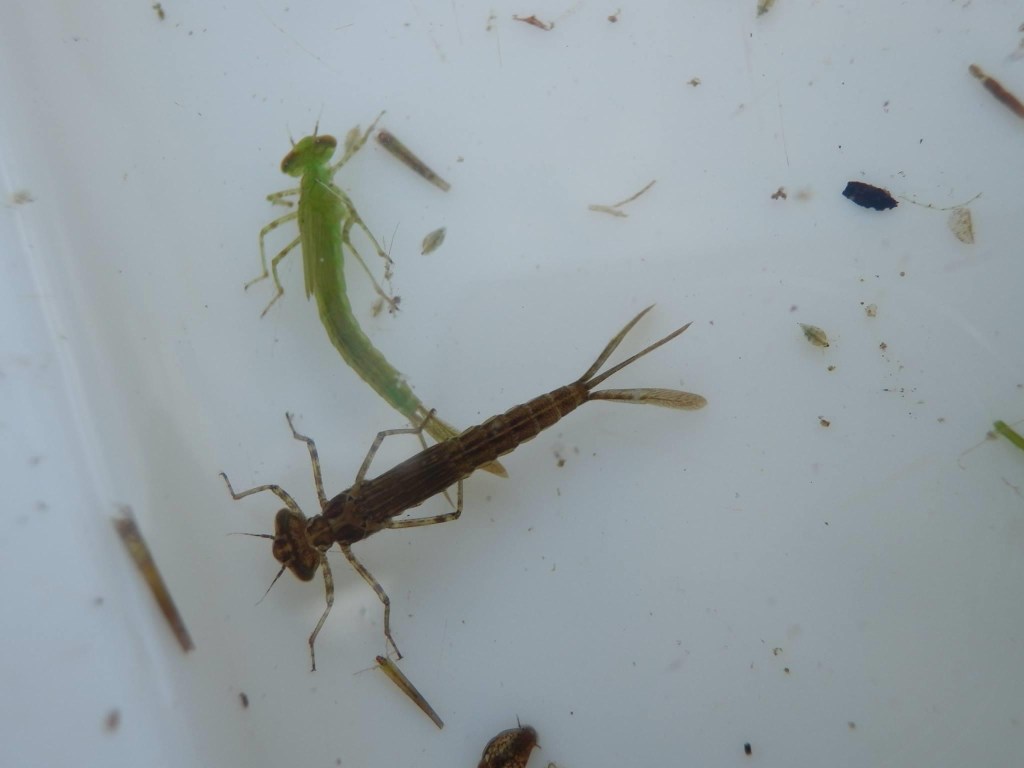
Damselfly nymphs 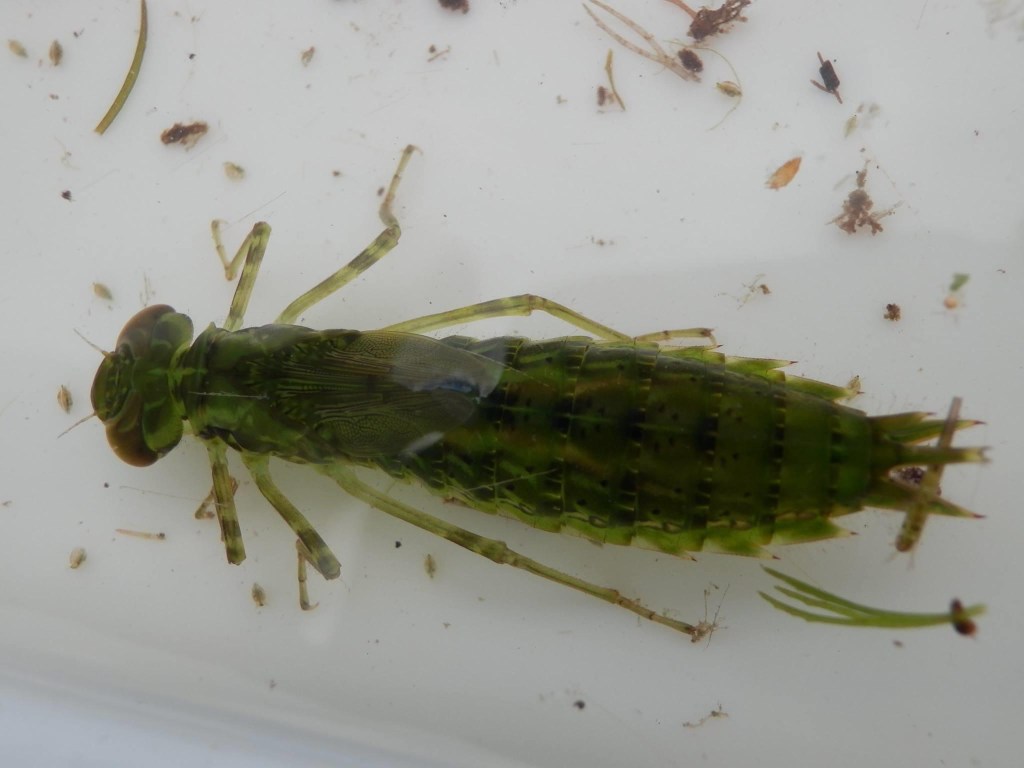
Dragonfly nymph 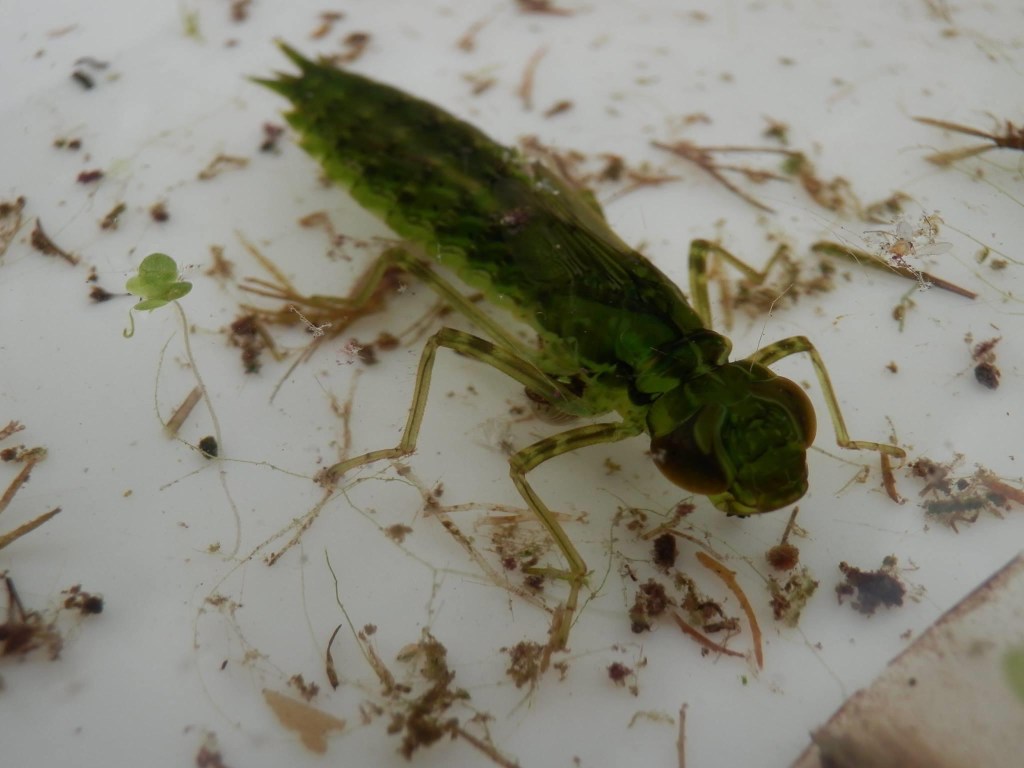
Dragonfly nymph
In order to grown, the nymphs shed their skin. Unlike mammals insects have an exoskeleton which needs to be removed to accommodate a growing body. A mammal’s skeleton is internal so growth can take place around it. Dragonflies may shed their skin up to 15 times as they grow.
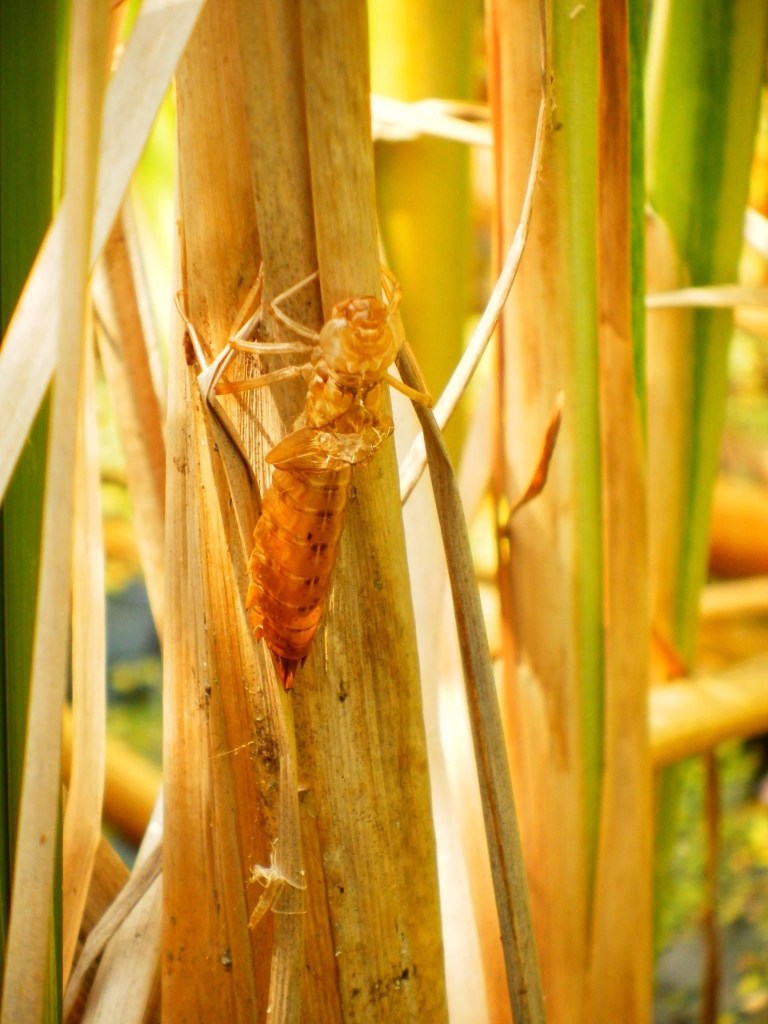
When a dragonfly nymph is ready to complete its metamorphosis it will leave the water by climbing up a reed or grass stem. Once dry the thorax will split and an air breathing adult emerge. From mid to late summer, the discarded skins or exuvia of emerged adults can be seen on plant stems along the edge of water bodies.
Further information
This has been a brief introduction to the wonderful world of Odonata. It may be all you need. Identifying dragonflies, and especially damselflies, to a species level can be much more complicated.
For more information on odonata identification have a look at the British Dragonfly Society’s wesite https://british-dragonflies.org.uk/odonata/species-and-identification/
I have a beautiful little book by Dan Powell, A Guide to the Dragonflies of Great Britain. Sadly, it’s out of print but new and used copies are available from online retailers and secondhand book sites.
Or you can go the whole hog and buy the highly regarded Field Guide to the Dragonflies and Damselflies of Great Britain and Ireland by Steve Chan & Steve Brooks and beautifully illustrated by Richard Lewington.
To find the best place to see dragonflies and damselflies near to where you live look here https://www.wildlifetrusts.org/where_see_damselflies_dragonflies
Footnotes
1 I have used the current place names of independent Zimbabwe. I grew up in the 1960s and 1970s when colonial names were still in use. Zimbabwe was known as Rhodesia (previously Southern Rhodesia), during colonial rule. The capital Harare was called Salisbury.
2Lake Chivero was called Lake McIlwaine when I was a child.
 Wild About Life