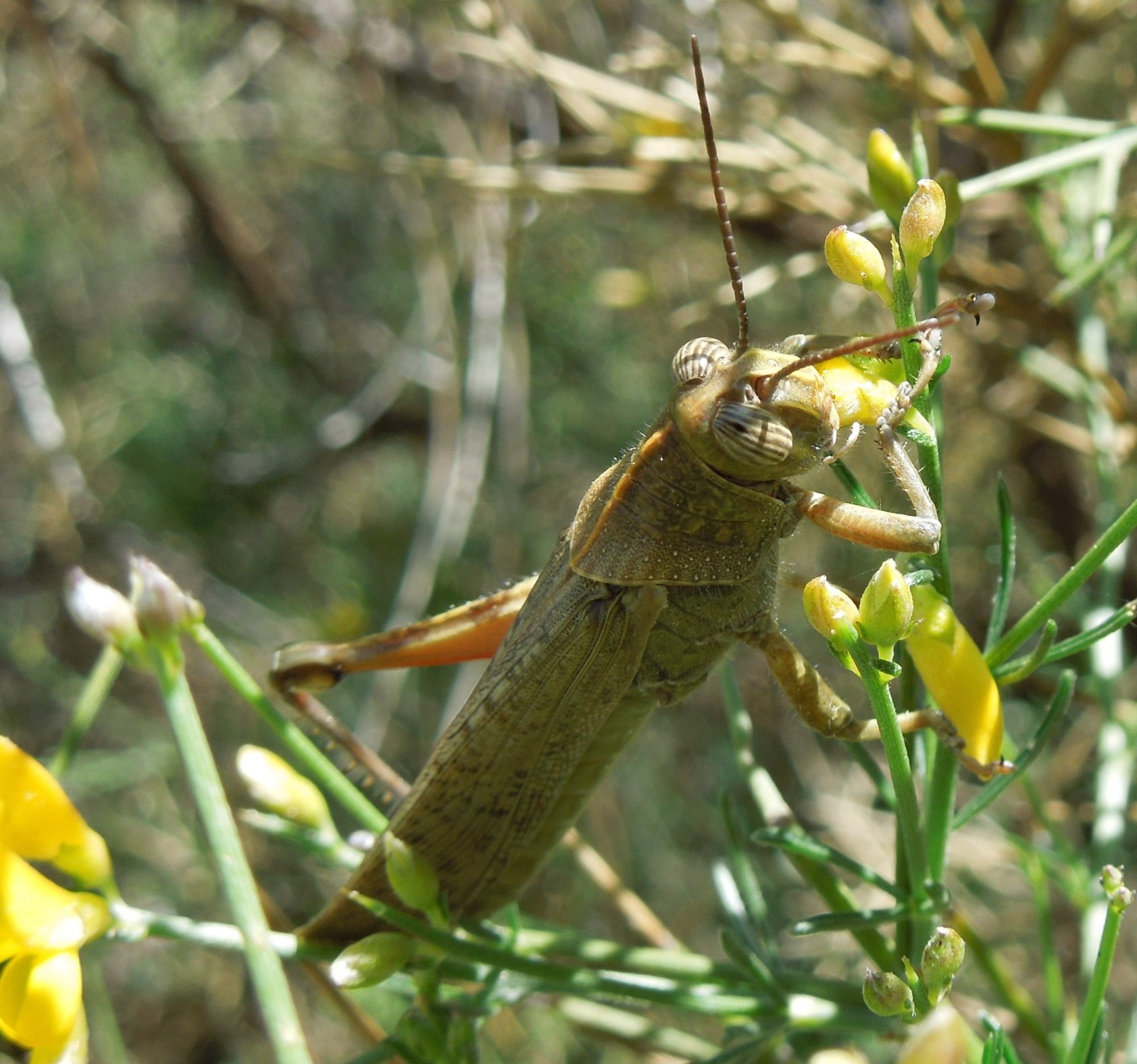
The strident chirruping and whirring of crickets and grasshoppers is a sound of the summer. Warm, sunny days near a meadow or even a small patch of longer grass are often accompanied by this music of hot and lazy days.
They have a distinctive look with a large head, stocky body and those characteristic long hindlegs with a sharp bend in the middle. And of course that ability to JUMP incredible distances relative to their size!
Both species belong to the order Orthoptera which means “straight wing” in Greek. Here’s a quick guide to help distinguish one from the other and then some more detailed information and fascinating facts.
1. Antennae
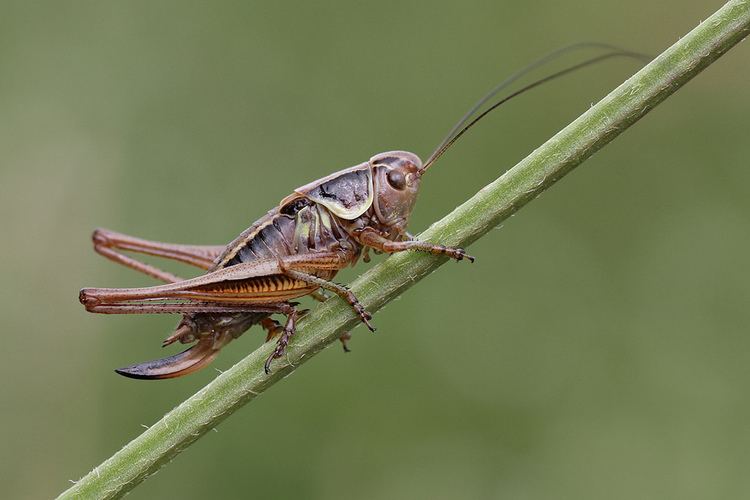
The quickest and easiest way to tell these insects apart is by looking at their antennae. Most insects have these sensory feelers which help them locate prey, find their way, identify each other and much more. Grasshoppers have relatively short antennae while crickets have extremely long ones. A grasshopper’s antennae are never longer than its body but a cricket’s can be as much as three times longer.
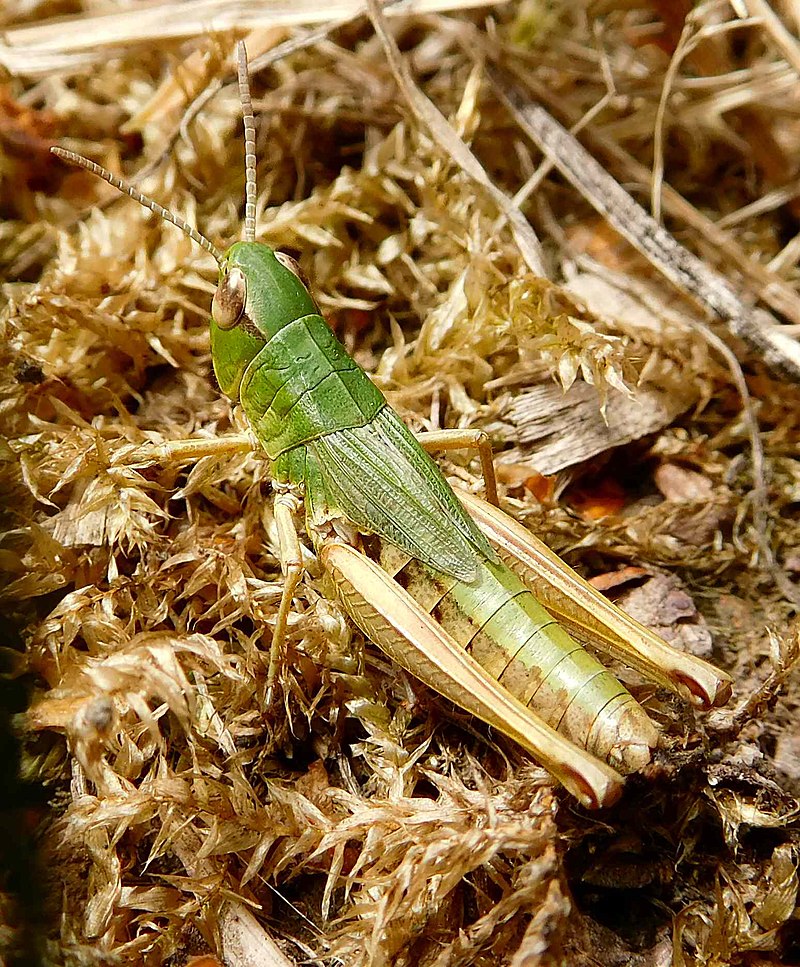
Meadow grasshopper, LWT Gunnersbury Triangle, London c. Ian Alexander 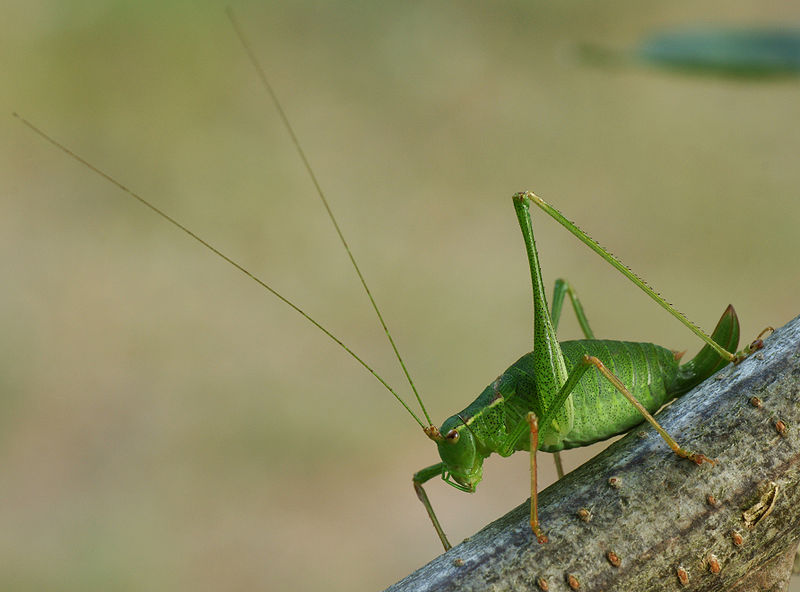
Bush cricket c. Leviathan
2. Behaviour
As a general rule, grasshoppers are active during the day and will usually be the ones jumping out of the way (or jumping onto you!) when you walk through long grass in the summer. Crickets are more crepuscular which means they come out at dusk.
Sound
The sound that crickets and grasshoppers make is called stridulation. Crickets stridulate by rubbing their wings together. Grasshoppers rub their long hind legs against their wings. If you manage to get close enough to a grasshopper to watch it looks as if their hind legs are vibrating they move so fast.
The parts that are rubbed together are called the file and the scraper and it is much like rubbing a comb along a piece of paper or card.
Watch this video of a grasshopper creating its remarkable sound! https://www.youtube.com/watch?v=nyglT-rWE5c
Crickets “hear” using small sound detecting organs on their front legs. Grasshoppers do the same but their sound detectors are located at the base of their abdomen.
Food
Grasshoppers mostly eat grass or other vegetation. Crickets have a more varied diet and also like to eat some meat, or at least other insects, as well.
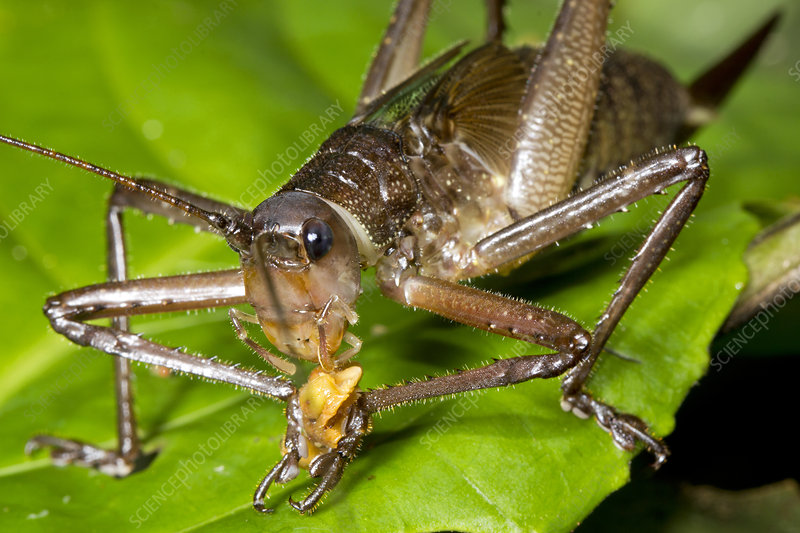
Bush cricket feeding on fruit by Dr Morley Read/Science Photo Library 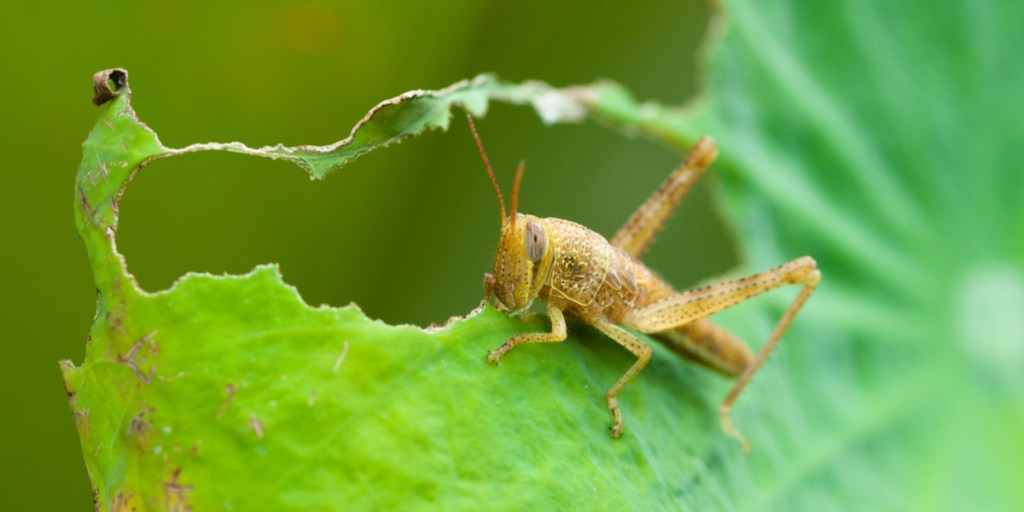
Grasshopper eating leaf
Both have powerful jaw structures to cut through tough cellulose and other plant material. Some crickets have no problem chomping through an almond. Like many plant eating insects they need to start eating along a narrow edge and so are highly unlikely to “bite” a person.
Quick check
Grasshopper
- short antennae – shorter than body length
- active in day time
- makes sound, stridulates, by rubbing hindlegs against wing edge
- eats only vegetable matter, mainly grass
Cricket
- long antennae – up to three times length of body
- may be crepuscular or active at dusk
- stridulates by rubbing wings together
- may animal as well as vegetable matter
Life cycle
Both grasshoppers and crickets have an incomplete metamorphosis during their lifecycle. They hatch from eggs into a nymph stage, basically looking like a mini-adult.
As the nymph grows it needs to shed its exoskeleton. This process is known as molting. Grasshopper nymphs undergo five to six moltings as they grow while crickets may have as many as ten. With each molting their structure changes as they move towards adulthood.
The adult insect’s wings take about a month to mature and once it is fully developed the adult is more mobile than the nymph. Neither grasshopper nor cricket nymphs have wings.
Females of both species lay their eggs using an ovipositor. This is a long sword shaped organ that protrudes from their abdomen. Many insects have such an organ and it is often mistaken for a stinger. It is not, and is only used for laying eggs.
Grasshoppers may overwinter as eggs. The female will lay eggs over a number of weeks, burying them deep into the ground at the base of grass stems.
Further facts and information
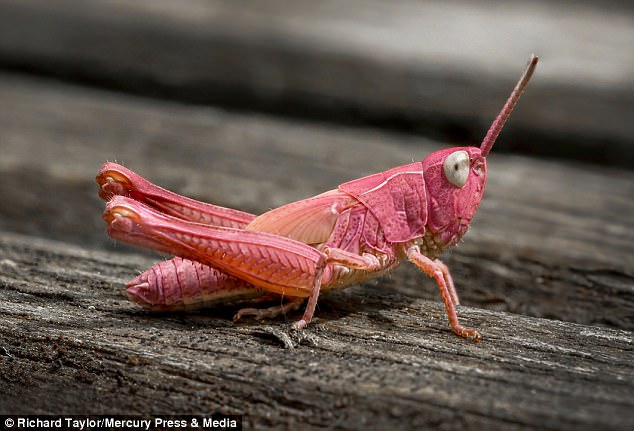
- Meadow grasshopper nymphs can be bright pink! It is a fairly rare occurrence but not uncommon. They are unlikely to survive to adulthood as they are easily spotted by predators.
- A locust is a type of grasshopper. In the 2019/2020 summer season east Africa has experienced its biggest locust swarms in 70 years. Large swarms are made up of many millions of locusts and can strip huge areas bare of vegetation.
- There are around 18000 species of orthoptera around the world. Many live in the tropics and around 700 are found in Europe, mainly to the south. There are only about 30 species in Britain with only a handful being found as far north as Scotland as they prefer warmer weather.
- Some crickets live almost entirely underground and are called mole crickets. Their nymphs live on plant roots and insect grubs.
If you have enjoyed this read you may also like:
 Wild About Life