4.30am and the alarm crashes me out of deep sleep with a heart-stopping, adrenaline fuelled lurch. Why have I done this to myself? Just go back to sleep, do it another day. No! I swing my legs out of bed without even opening my eyes, not giving myself the chance to sink back into oblivion. It’ll be worth it.
Fifteen minutes later and I’m dressed, flask of tea made and heading to the park. It’s the end of April and as soon as I’m out of the door I start to hear birdsong. Just the urban regulars at first, blackbird, robin and a great tit. This rare hour before dawn, light seeping from somewhere but the sun still a long way off. Even in central London the traffic is quieter and this year, of course, almost entirely absent.
Sleep is well and truly shrugged off and in its place an excited anticipation at what is to come. The sky is clear, the last few stars still faintly visible. It’s chilly, always a little colder than expected and experience has taught me to wear a woolly hat and gloves. The flask of tea in my backpack seeps a little warmth through my jacket and I quicken my pace, impatience pushing me on. A hundred metres from the park gates I can already hear the sound of dozens of birds, still faint through distance but growing stronger at every step. Relief, it’s still before 5am but the park gates are already open as if expecting me.
Tarmac and paving stones, the silence of walls are replaced by life as soon as I’m through the gates. The smell of dew damp grass, spring warmed earth and early blossom feels like a balm with every breath. And with each step the volume increases. It’s not yet light enough to see anything but the outline of branches against the sky but the mounting orchestra around me betrays the presence of a thousand birds. It’s like a draught of light, swallowed to rejuvenate the soul. A glowing ball of crystal sharp notes joins the throng of others in a symphony like no other.
I want to stop and stay, absorb the wonder just a few steps into the park but make myself continue, knowing it will be even better once I’m further in away from any traffic sound and far from street lights. I walk on, alone in this beautiful and vast open space in the heart of London. Regent’s Park, once the preserve of hunting royalty now forever protected for the likes of me and, for the time being, I seem to have it all to myself. Every year that surprises me. I know it was an effort to get up so early but the pay off is so huge I always think more will have done the same. This year I’ve ventured out a couple of weeks earlier than usual as the weather has been good, warm and dry and I know the birds will already be busy. Perhaps that is why I remain alone for so long – not even a fellow birdwatcher easily recognisable by the lump of binoculars on chest.
As I’m about to cross over the road from the formal gardens to the wilder reaches of the park I freeze as the drumming of a woodpecker joins the birdsong. I hadn’t expected to hear that so early but he is obviously up and marking his territory too.
I look up searching for likely branches. Dead wood makes a better sounding board, creating an echo that will reverberate further, signalling the strength and ability of the male bird. I imagine what it must feel like to rapidly bash your head against a hard surface, several times a second. The woodpecker’s anatomy has evolved remarkably to cushion the considerable force exerted on its skull. A disc of spongy bone at the base of the beak acts as a shock absorber, dissipating the force and protecting the bird from considerable cerebral trauma. The sound comes again and this time I spot it, red head just visible in the dim light. And then it’s off, chattering as it swings its way across the road as if reaching invisible markers before dipping and swinging up to the next.
It’s getting lighter and I quicken may step to reach the point I’m aiming for before the sun peaks over the horizon. I am now surrounded by sound and I make myself just enjoy the symphony of sound without trying to separate out the individual calls. Sometimes its good to put aside that human need to constantly identify and name and just listen, become a part of the dawn and not a separate observer, to feel from the inside and merge with the life around me as just another organism.
I’ve reached the perimeter fence of the bird breeding area, protected from runners and dog walkers, families and football – and me. Inside, a wilderness for the wildlife to thrive away from human intervention and disturbance. Water one one side, woodland the other and ahead the growing grass and flower stems of early meadow and a patch of thorny scrub. Several habitats with their different species coming together and giving the opportunity to see and hear the greatest number of birds. I prop my elbows on the fence creating a natural tripod for my binoculars, though it’s still a little dark for them to be much use. Instead, I close my eyes and let the waves of sound surround me.
There’s a robin close by, its short bursts of flutey song making it sound as if it keeps forgetting the tune it’s meant to be singing. From a little further off, across the first stretch of water, a wren contributes its piercing and complex melody ending each burst in a buzzing trill. Impossibly loud for such a tiny, tiny bird. I can’t see it but it’s clear in my mind, tail ticked upwards, beak agape, busily flicking from one branch to another, never still.
My heart soars as a blackcap starts up in the brambles behind me. I turn and there it is, posing on top of an arching bramble branch, outlined against the lightening sky. My favourite song bird. There’s something about the liquid, busy chattering, that just makes me happy. And it’s such a pretty bird, not flash or bright but a lovely shape and the males so sharply dressed with their neat black hats.
There are, of course, blackbirds all around me. Close by, further off, far away. Some will already have broods and won’t be joining the chorus but many are still in full song. A rustle in the undergrowth near my feet betrays the presence of a female, not as striking as her shiny black male mate with his bright yellow bill but perfectly camouflaged as she forages for worms, skilfully organising them in her ridged beak to take to the gaping mouths back in the nest.
I’m startled by the sudden quacking of ducks, quickly joined by the honking of geese as something disturbs the water birds in the reeds on the other side of the fence. A fox perhaps, making its way along the waters edge in search of eggs or an unsuspecting sleeping bird.
The finches have joined in. I’m suddenly aware of both gold finch and green finch song adding to the orchestra. A little flock of goldfinches chatters overhead, presumably making for the birdfeeders in the enclosure behind me. And song thrush, the first one close by then another sounding from further away, probably from the garden of St John’s Lodge across the expanse of mown lawn to my left. They’ll both be perched on branches about two thirds of the way up a large tree, facing outwards, proclaiming their presence with a complex composition of repeated phrases. A song that grows in complexity as they age, advertising experience and strength to interested females.
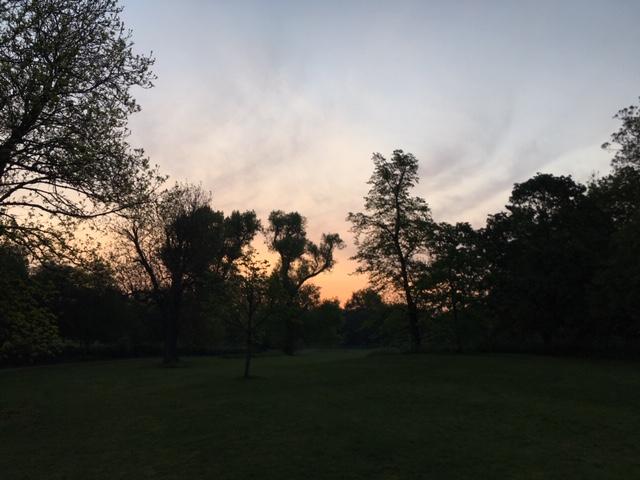
I revel in the sound around me, grinning from ear to ear, so glad I leapt out of bed when it would have been so easy to roll over and go back to sleep. I head towards the open grass wanting to get a photograph of the sun as it rises above the trees. A whooping whistle echoes loudly across the park, far louder than anything I’ve yet heard. It’s rapidly joined by several others and my brain scrambles around to identify the source. Ah, gibbons! The monkeys and apes in London Zoo on the northern border of the park are also waking up and there dawn calls incongruously join those of the English songbirds. Then the deep chested, reverberating rumble of a lion’s roar adds the base note to this marvellous symphony.
The sounds of European birds joined by the apes of South America and the big cats of Africa somehow seems fitting in a London dawn chorus, our wonderful city of people from around the globe. Asia joins in as a group of ring-necked parakeets screech overhead.
 Wild About Life