
Journey there
A bad few days. The novelty of furlough and endless hours to fill has worn off. The exhilaration of recovering from the virus is long gone. Rambling walks in the park are failing to lift my spirits. The park is busier, more people are returning and with them, litter. Bottles in the long grass, masks and gloves on the paths, soggy and soiled clumps of tissue under trees. I get angry each time I spot so much as a sweet wrapper. Thoughtless, selfish acts of vandalism. I get angry at the runners sweatily, breathily skimming past me, their blinkered focus appears to blind them to distancing rules. I get angry at families walking, scooting, cycling four abreast across a path, coming towards me, no one dropping into single file. Am I invisible? Am I less entitled to space because I walk alone?
I am just angry – and anxious and bored, I suppose. I need a change. Allotted time for exercise has increased so I decide to venture further afield. The Thames tide table for the following day is favourable, low tide at 11.30am. I can get down there for 10.30am have an hour on the foreshore before the tide starts to turn and an hour after slack tide.
The next morning I awake, excited and a little nervous. This will be my first adventure in almost three months. ‘Adventure’. BC (before Covid), such a trip was a weekend regular. Part of a day that included an exhibition, film or theatre on the Southbank. Now I’m mounting my bicycle feeling intrepid, heading into the unknown, a bit anxious about breaking rules. I’ve checked, I’m not.
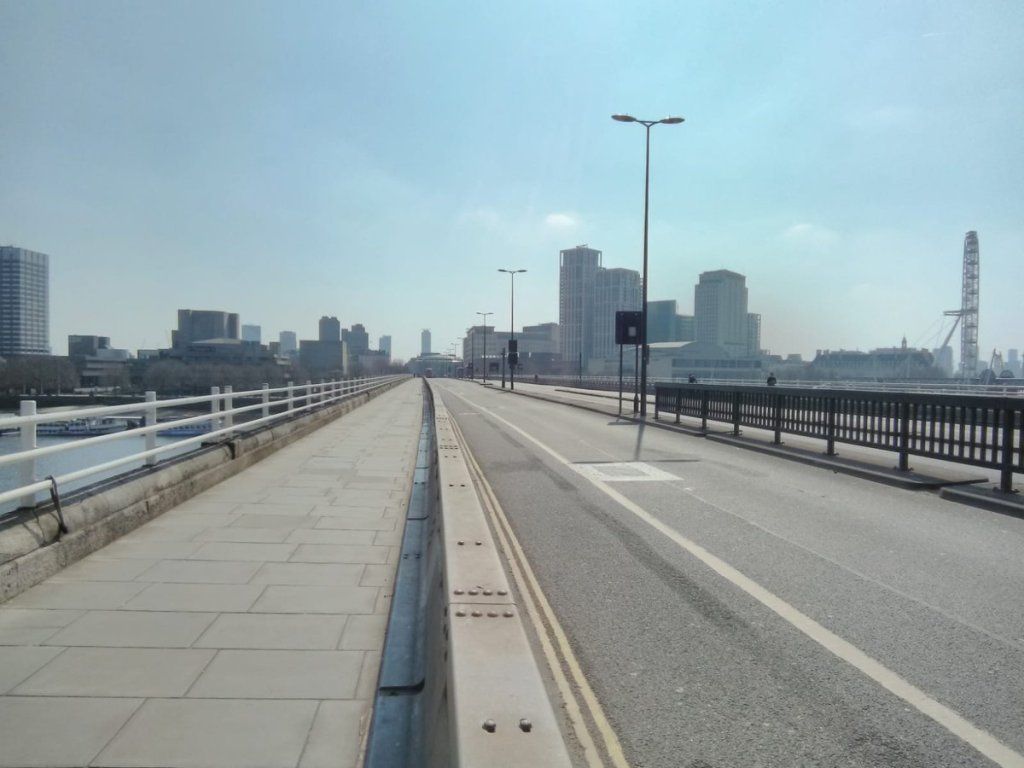
It’s another beautiful day. This warm and sunny gorgeous spring seems to go on and on. The sky is clear and so are the roads. A few other cyclists and a bus every now and then, cars all but absent. It’s so quiet, so beautiful. I can hear birds and can look up at the mish mash of architecture, the flashing light through the leaves of London’s plane trees. A zig zag through Covent Garden then whoosh, I’m freewheeling down the approach and on to Waterloo Bridge. I have it all to myself. The whole bridge. I start laughing loudly then wildly singing and whooping. The trip is already worth it and I’m only just crossing the river.
On the beach
I lock up the bike outside the Founder’s Arms, a pub on the Thames path overlooking the river. It is of course shuttered and empty, opportunistic plants sprouting between the paving stones at the base of the stairs to its front door. A memory of Morris dancers and friends crowds to the front of my mind. Right here, a damp and chilly autumn day filled with laughter, beer and music. I turn away and head down the flight of deep and shallow steps leading to the beach below.
The river is at the end of its race to the sea, gently lapping against the pebbles and rubble. It’s so quiet. There are no ferries churning through the water with their cargoes of waving tourists and suited city workers. The lack of bridge traffic makes every announcement from the overhead platform at Blackfriars Station plaintively audible. Announcing to no one.
My eyes automatically scan the stones and bones at my feet. Centuries of habitation along this shore makes it a treasure trove of discarded items. Bits of buckle, broken clay pipe stems, horseshoe nails, roof slates, bits of basin and pot and, of course, the bones. I love the bones. Stained brown by the river, rubbed smooth by who knows how long in the water. Ribs and vertebrae, jawbones and femur heads, flat pieces of skull, long and strong tibia and fibula. Animal bones. Sheep and cow, horse and pig, chicken and goose. And surely some human.
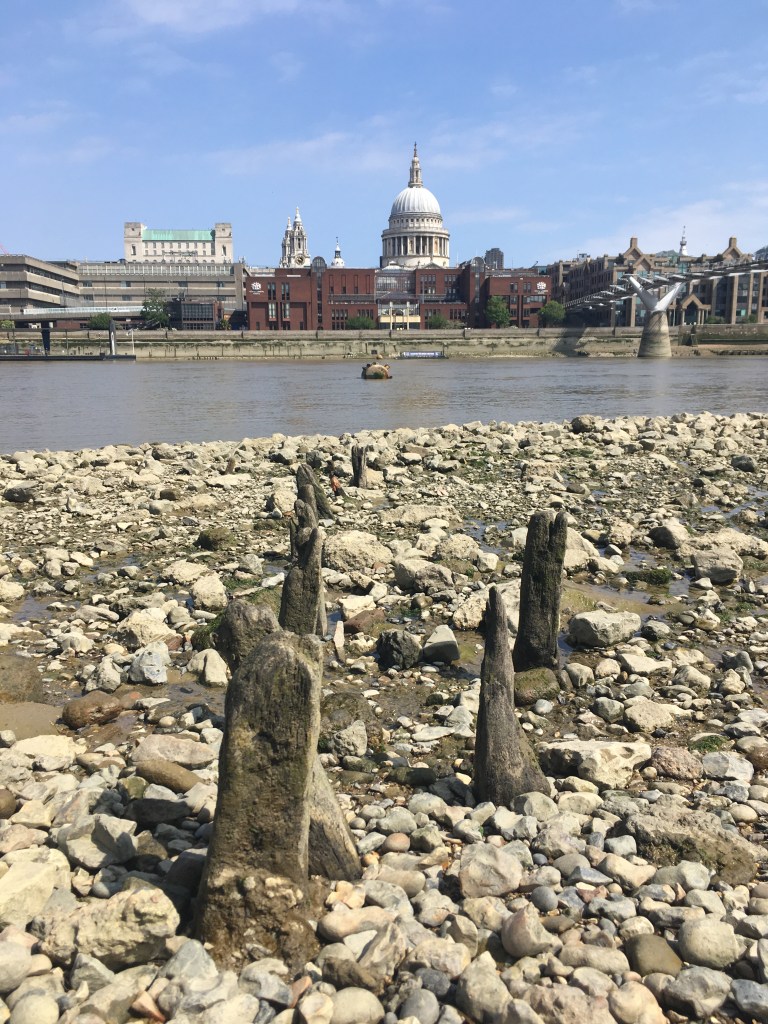
Touching them transports me back in time, imagining the noise and smells of streets teeming with animals as well as people. To a time when the scavenging birds were not just crows and pigeons but also red kites. When water and beer were transported in clay jars and washing was done in pottery bowls. When this stretch of ancient river was still a thriving port, welcoming ships from across the globe to unload their exotic cargoes.
The crow
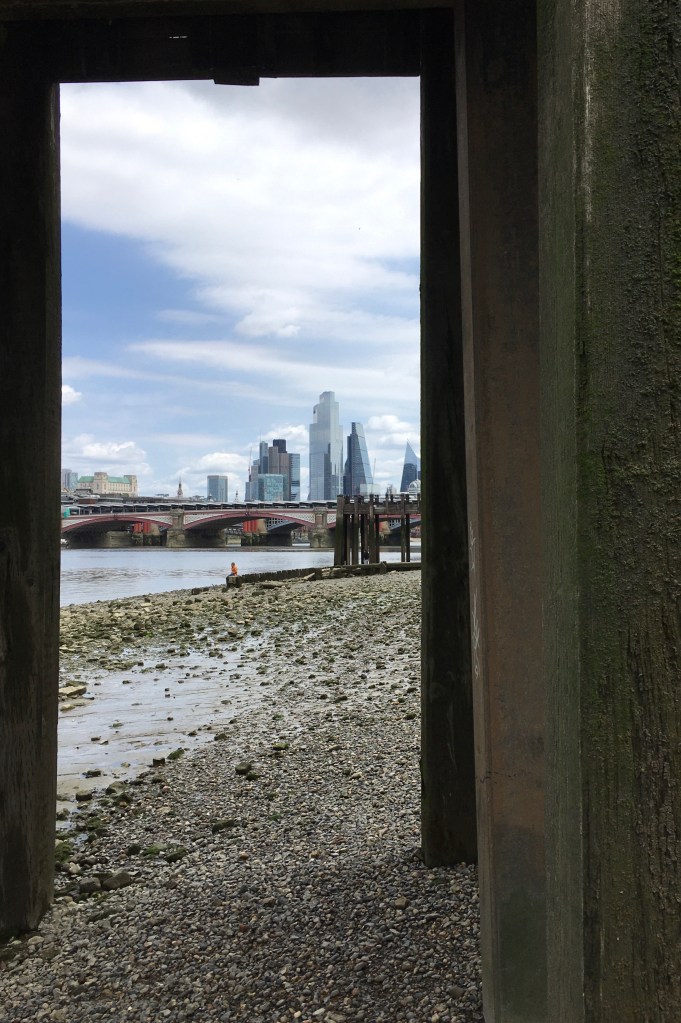
I’ve moved only a couple of hundred metres in half an hour, zig-zagging up and down the ground, avoiding the patches of smooth and sucking mud, stepping on bigger stones and over tidal pools once I’ve checked them for life. It’s all so clean. Barely any litter. I look up and there is St Paul’s, from across the river clearly visible between the ever growing barrier of new buildings. Thirty years ago the dome was still an imposing feature from pretty much every angle. Now it’s so surrounded by new steel and glass it seems one day the skyscrapers will lean together and it will disappear beneath their jagged shoulders, the smooth curves no match for the cutting edge of progress.
The sound of pebbles moving makes me look down. A crow is flipping stones, searching for morsels left behind by the receding water. It half-heartedly lopes away two steps as it sees me looking, then cocks it head and fixes me with one shiny eye, beak angling upwards towards me. Then I swear I see it shrug before it resumes its stone flipping, ignoring me entirely. I follow it for a bit engrossed by its skill and confidence. Whatever it’s eating is too small for me to identify but after nearly every flip there’s a quick-as-a-flash grab before it stretches its neck forward, manoeuvres the target in its beak and swallows.
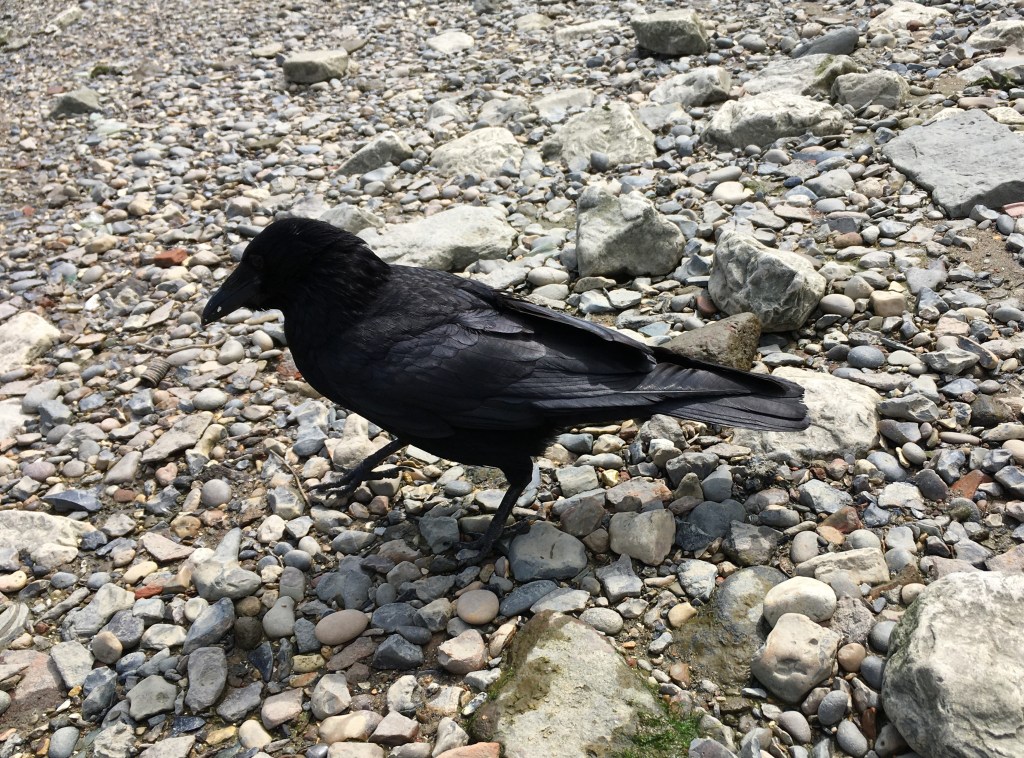
I sit on a rock and watch him, or her. It comes right up to me, my presence incidental. Glossy black feathers with an oily iridescence of purple and green, the sturdy beak probing and flecked with grains of sand. A rasping call sounds from further up the beach and it effortlessly spreads its wings and flies off to join whoever is calling. Mate, perhaps.
Pigeons
I get to my feet with a grunt of effort and continue down the shingle, walking along the water’s edge. It’s slack tide, that pause between the rushing in and sucking out dictated by the moon in our partnered dance through space. A small flock of pigeons are washing and preening in the still shallows, throwing up glistening droplets of water. They’re more wary than the crow and edge away as I approach, their contented coos changing with a note of warning.
They’re bathing beneath the looming wall of Bankside, the Tate Modern and its sheer sides of Victorian brickwork, uninterrupted by windows. A former power station now housing works of art. But the ledges of brick high on its chimneys also provide perfect nesting platforms for city peregrines. The fastest creature on earth, an aerial killing machine, a beautiful falcon that has made our man-made cliffs its home. The pigeons are right to be wary. They are the favoured prey.
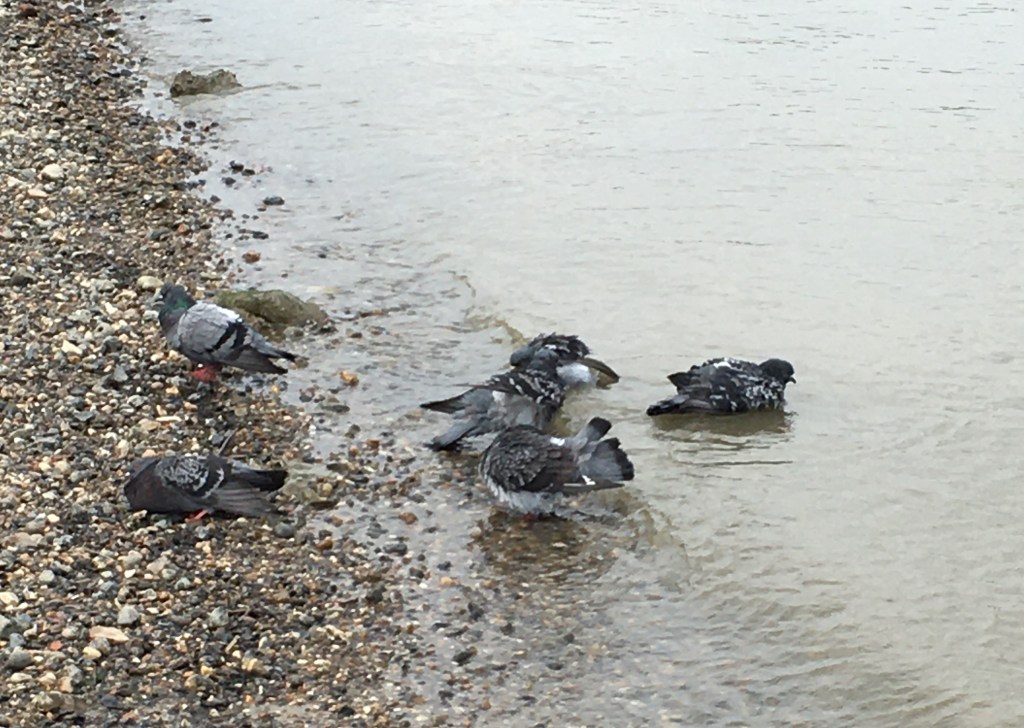
I don’t want to disturb them so stop and watch through binoculars. Two or three birds sit a little higher up the beach ruffled and puffed, drying off after their bath. Their heads and beaks deftly work through the feathers smoothing and straightening, winkling out grit and parasites dislodged by the water.
The sound of children’s laughter reaches me and I look round. A girl and younger boy are running around throwing stones. It’s good to hear their happiness and watch their freedom. There’s another family about 50 metres away and a group of teenage girls sitting in a distanced circle. It’s nice, a tiny bit of normality. I watch the running children then realise that every time they throw there’s a flutter in front of them. They’re throwing stones at pigeons. My stomach lurches at their innocent cruelty and I scan the beach for a parent.
There she is, mother. Standing near the embankment wall talking on her phone and absentmindedly watching the children. She knows what they are doing.
My mind is telling me to walk away, avoid confrontation. Everyone’s anxious and on edge about the unseen menace amongst us. But I can’t. I purposefully approach her and stop a few metres away, more than socially distanced.
“Excuse me, ma’am. Are those your children?” She looks up, suddenly concerned and says yes, they are.
“Do you think it’s ok for them to be throwing stones at birds?” Her expression changes to annoyance. She quickly says something into the phone then shoulders it.
“They’re only pigeons. I don’t count them as birds. They’re disease carrying flying rats.” Here we go.
“They’re living creatures. Do you think it’s ok for your children to throw stones at living creatures?” I ask.
“You can’t tell me how to raise my kids,” she says defensively. I haven’t, I’ve just asked her a question. “We’ll just have to agree to disagree on this one,” she adds dismissively.
I take a deep breath. Don’t get angry.
“No ma’am, I can’t agree to that.” And I launch into my thing. They’re actually rather clean birds and I’ve just been watching them wash. They carry no more disease than ourselves or other animals. I suggest she reads some scientific information. Perhaps a step too far.
“You can’t just talk to me like this, you’re not a teacher.”
“Actually, I am,” I reply. She’s taken aback and doesn’t immediately respond. I quickly fill the gap telling her I teach children science outdoors. I try to get them to respect the natural world around them, to investigate and revel in its wonder, to value our urban wildlife. I say I’m an amateur ornithologist, I love birds and I’m speaking with some knowledge.
By now all the teenagers are listening. A bit of excitement. The children have also returned to their mother and are standing closely either side of her, suspicious of this animated stranger, hearing everything I’m saying. They’re about seven and nine years old. Old enough to know, old enough to be aware.
“I’ve been making friends with pigeons,” the boy says suddenly. The lie tells me he’s heard what I’m saying. I switch to teacher mode, focusing on him.
“That’s fantastic! Well done,” I say warmly. Then I start to tell him about the other birds he can see on the beach and about the peregrines on the building behind. He’s listening intently. I’m surprised his mother hasn’t interrupted. She’s letting me speak to the children. Have I reached her? I hope so.
“The peregrine’s favourite food is pigeon,” I finish with, raising my eyes to Mum. She mutters something I don’t catch. I start to move away saying I hope they’ve found out something new and continue walking. The teenagers watch me as I leave. One giggles and another gives me a little nod.
My heart is pounding. Have I done the right thing? Have I spoiled their outing? Have I spoiled mine? Stop. I have done the right thing. We humans are just part of this big thing we call Nature. We’ve done our best to destroy it, to bend it to our will. I have a voice and knowledge and I am right to use them to defend creatures that can’t defend themselves. But really I’m just sad. Sad that a mother was not teaching her children to love all around them. Is that how it starts? Persecution, bigotry, racism? Being allowed to throw stones at pigeons.
Geese
I head back down to the water’s edge. The tide has turned, eddies and swirls visible in the middle of the river as the flow starts to reverse. A pair of greylag geese are bathing. Pink legs protruding from the shallows while their sinewy necks writhe against their backs, beaks furrowing channels through their feathers. One walks out of the water, spreads its wings and beats them. A rainbow momentarily forms in the flying spray. I give a little sad laugh.
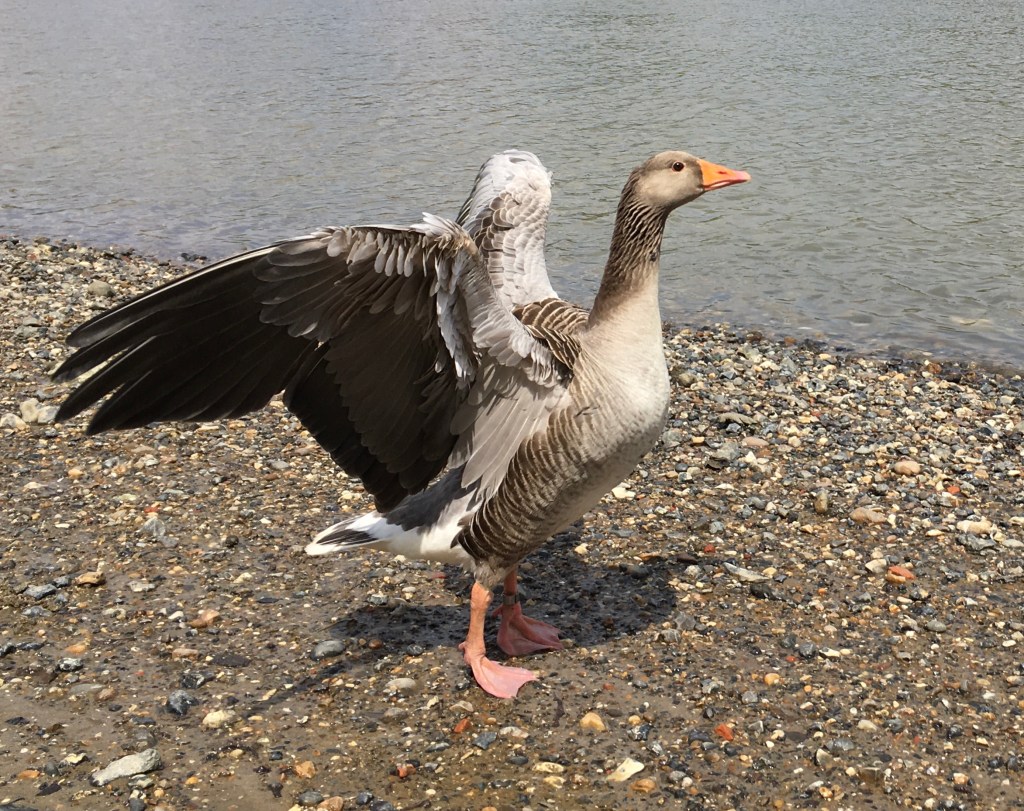
They let me watch and I sit down, heart slowly returning to normal. I marvel at their beauty. The pattern of feathers, individual and as part of such an intricate design. Birds, I love them. Scaled legs and feet, that wondrous ability to fly, one of our closest links to dinosaurs.
The sight has returned me to the beauty of the day and the feeling of privilege at sharing it with these birds. Sassy London birds that let us get up close, that approach us expectantly, that treat us as their providers. Not everyone throws stones.
It’s time to go. The foreshore is half the size it was when I arrived. The sea is rushing silently in, forming a wave on the downstream side of bridge supports and gradually rising up the shingle. I walk to the bottom of the nearest exit ramp and wait for a woman with a little dog on a lead coming down towards me. The dog is business-like and proprietorial, nose to the ground. Her patch.
“Thank you,” she says with a smile as they reach me. “What a beautiful day!”
“Yes. Yes, it is,” I reply. “Enjoy your walk.”
 Wild About Life
I love that you were brave enough to step in with the kids. ❤
LikeLiked by 1 person